If you run a medical practice, you’ve probably heard that SEO can bring in a steady flow of new patients. The next question is always the same: how much will it cost?
In 2026, most medical practices spend between $750 and $5,000+ per month on SEO. Small local clinics usually sit at the lower end of that range. Multi-location practices and hospitals often invest $10,000+ per month to compete across several cities or states.
Healthcare SEO costs more than general SEO for a simple reason. Google holds medical content to a higher standard because it affects people’s health. That means more expert-reviewed content, stronger trust signals, and careful handling of patient privacy.
In this guide, we’ll break down what medical SEO really costs, what drives the price up or down, and how to budget for it without wasting money.
Turn Searches into Patients with the Right Healthcare SEO Plan from IndeedSEO
What Is Healthcare SEO?
Healthcare SEO is the process of helping a medical website rank higher on Google when patients search for treatments, conditions, or doctors near them. Done well, it turns searches like “pediatrician near me” or “knee pain specialist” into booked appointments.
But SEO for medical practices isn’t the same as SEO for a retail store or a restaurant. It comes with its own challenges:
- YMYL standards. Google classifies health content as “Your Money or Your Life,” so it judges accuracy and credibility more strictly.
- E-E-A-T. Content needs to show real expertise, ideally written or reviewed by qualified medical professionals.
- Patient privacy. Forms, tracking tools, and analytics must be set up so they don’t expose patient health information.
- Tone and clarity. Content has to be accurate and professional, yet easy for patients to understand.
All of this takes more time and specialist skill, which is why medical SEO is priced differently.
How Much Does Medical SEO Cost?
Here’s what healthcare SEO typically costs, depending on how you choose to work with an agency:
| Type of service | Typical cost |
|---|---|
| Monthly retainer | $800 to $5,000+ per month |
| Local SEO for a single clinic | $750 to $2,500 per month |
| Multi-location SEO | $2,500 to $10,000+ per month |
| One-time SEO project | $1,500 to $10,000+ |
| Hourly consulting | $100 to $300 per hour |
These ranges are based on the healthcare SEO projects we quote and manage for medical clients. Your actual cost will depend on your specialty, your location, the condition of your website, and how quickly you want to grow.
Most practices choose a monthly retainer. SEO builds over time, and ongoing work (new content, link building, local updates) is what keeps rankings climbing.
Medical SEO Pricing by Practice Type
Not every practice needs the same level of investment. A small family clinic in a quiet town doesn’t face the same competition as a cosmetic surgery center in Los Angeles.
Here’s how costs usually look by practice type:
| Practice type | Typical monthly cost | What it usually covers |
|---|---|---|
| Solo practice or small clinic | $750 to $2,500 | Google Business Profile, local SEO, service pages, reviews |
| Dental or specialty clinic | $1,500 to $3,500 | Local SEO, treatment pages, content, link building |
| Plastic surgery or cosmetic practice | $2,500 to $5,000+ | Competitive keywords, procedure content, reputation management |
| Multi-location practice | $2,500 to $10,000+ | Location pages, citations for each branch, reporting by location |
| Hospital or health system | $5,000 to $10,000+ | Technical SEO at scale, content hubs, physician profiles |
If you’re in a highly competitive specialty, like plastic surgery or dentistry, expect to be toward the higher end of your range.
What Affects the Cost of Healthcare SEO?
Healthcare SEO pricing isn’t fixed. A few key factors shape how much work your website needs and how long it will take to see results.
1. Size and Complexity of Your Website
A five-page clinic website is much quicker to optimize than a hospital site with hundreds of service, doctor, and location pages. Larger sites need deeper technical audits, more content work, and a stronger internal linking structure.
2. Local vs. National Reach
A single clinic competing in one city mainly needs strong local SEO: an optimized Google Business Profile, consistent listings, and good reviews. A healthcare brand targeting several states needs a much broader campaign, which costs more.
3. Your Website’s Current SEO Health
If your site has never been optimized, or it has issues like slow speed, broken pages, duplicate content, or spammy backlinks, those problems need fixing first. That upfront work can add to your initial cost.
4. Specialty and Keyword Competition
Some specialties are far more competitive than others. Keywords for cosmetic procedures, dental implants, or chiropractic care are often contested by well-funded practices, so ranking for them takes more effort.
5. Content Needs
Patients research a lot before booking. Treatment pages, condition guides, FAQs, and blogs all help you rank and build trust. The more content you need, and the more medical review it requires, the higher the budget.
6. Technical SEO Requirements
Page speed, mobile usability, secure browsing, structured data, and accessibility all affect rankings. A site missing these basics needs more technical work before content can perform well.
What’s Included in a Medical SEO Package?
A good healthcare SEO package covers much more than keywords. Here’s what you should expect:
- Healthcare keyword research. Finding the terms patients actually search, from symptoms to “near me” searches.
- Content writing and optimization. Clear, accurate service pages and blogs that match patient intent and follow medical content standards.
- Local SEO. Google Business Profile optimization, consistent name, address, and phone details, local citations, and review management.
- Technical SEO. Fixing speed issues, broken links, and mobile problems, and adding structured data so Google understands your pages.
- On-page SEO. Better titles, headings, and internal links so both patients and search engines can navigate your site easily.
- Off-page SEO. Earning quality backlinks from trusted health websites and directories.
- Privacy-first setup. Keeping patient health information out of contact forms, analytics, and tracking tools unless proper safeguards are in place.
- Reporting. Monthly reports that show rankings, traffic, calls, and appointment requests, not just vanity metrics.
How Long Does Medical SEO Take to Work?
SEO isn’t instant, and it’s worth knowing what to expect before you invest. Most medical practices start seeing ranking improvements within 3 to 6 months, with steady patient growth from search after 6 to 12 months. Local SEO for a single clinic often moves faster than a national campaign.
Here’s what a typical first year looks like:
- Months 1 to 3: technical fixes, Google Business Profile setup, keyword research, and core service pages.
- Months 4 to 6: regular content publishing, local citations, review growth, and early ranking gains.
- Months 6 to 12: link building, content expansion, and consistent growth in calls and bookings.
Budgeting Tips for Healthcare SEO
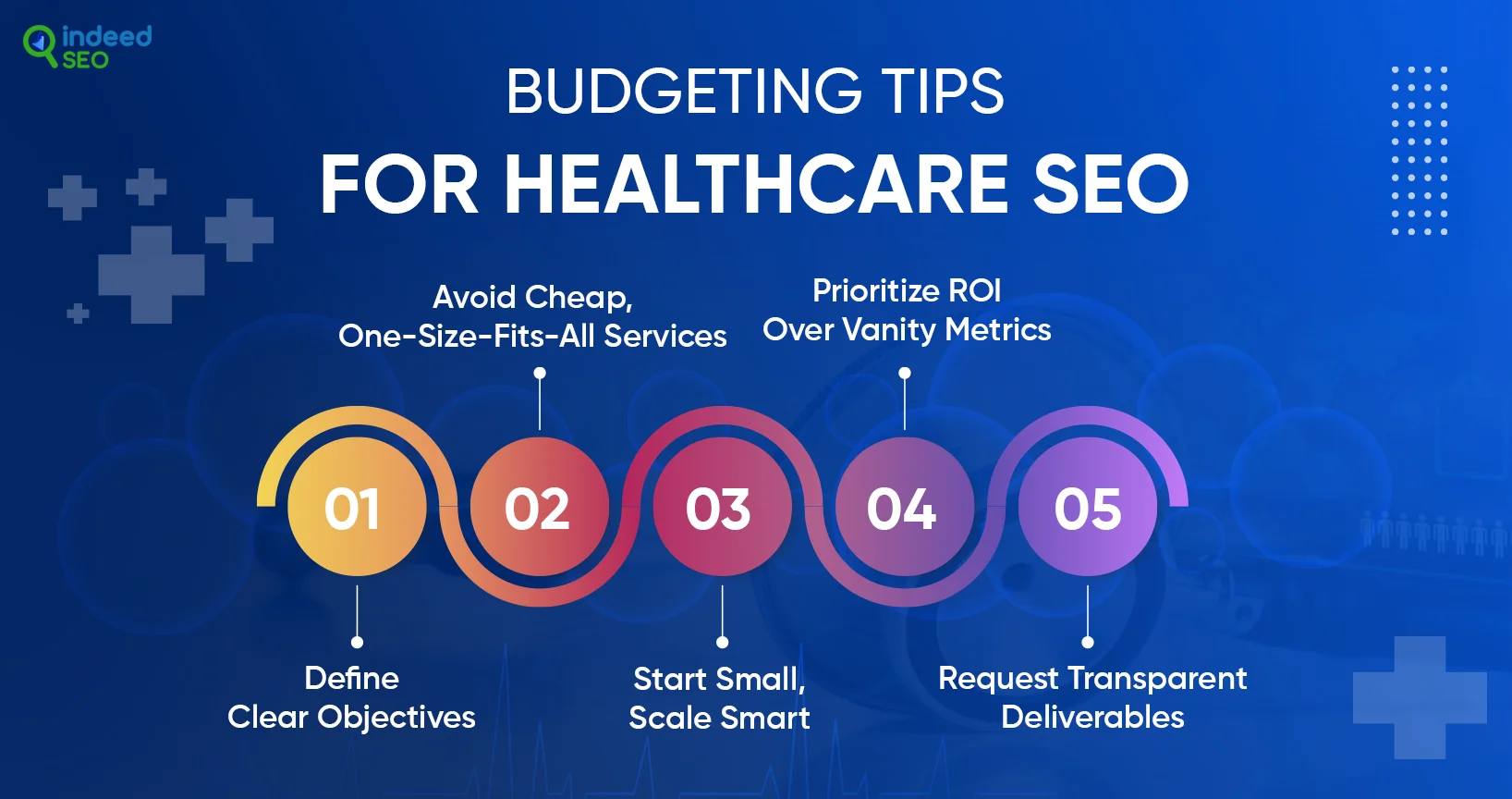
The cheapest option is rarely the best value. Here’s how to set a budget that actually pays off.
Set Clear Goals First
Do you want more local patients, more bookings for one specific treatment, or visibility across several locations? Your goals shape your keywords, content, and budget, so decide on them before you compare quotes.
Be Wary of Very Cheap SEO
Low-cost SEO packages often rely on spammy backlinks or generic content. In healthcare, that can hurt your rankings and your reputation. Look for an agency with real medical SEO experience and ethical methods.
Start Small, Then Scale
You don’t need everything on day one. Start with the essentials, like local SEO and your core service pages. Then add content, link building, and conversion improvements as your traffic and revenue grow.
Focus on Patients, Not Just Rankings
Rankings and traffic only matter if they lead to calls and appointments. Ask how the agency will track bookings, form submissions, and phone calls from search.
Ask for Clear Deliverables
A good SEO partner tells you exactly what you’re paying for each month: content published, links earned, technical fixes made, and keyword progress. If a quote is vague, ask for details before you sign.
Why Choose IndeedSEO for Healthcare SEO?
At IndeedSEO, we help hospitals, clinics, wellness centers, diagnostic labs, and private practices turn online searches into booked appointments. Our healthcare SEO services combine technical SEO, local SEO, and expert-led content, all built around Google’s standards for medical websites.
Here’s what you can expect when you work with us:
- Transparent pricing with no hidden fees
- A strategy focused on patient growth and ROI
- Technical, content, and local SEO under one roof
- Privacy-first practices for forms, tracking, and analytics
- A dedicated team that reports clearly on progress every month
Conclusion
Medical SEO is an investment in patient trust as much as rankings. Most practices spend $750 to $5,000+ per month, and the right budget depends on your specialty, location, and growth goals.
If you’d like a clear quote with no surprises, our healthcare SEO team will review your website and recommend a plan that fits your practice.

FAQs
How much does healthcare SEO cost per month?
Most medical practices spend $750 to $5,000+ per month on SEO. Small local clinics are usually at the lower end, while multi-location practices and hospitals can spend $10,000+ per month.
Why is medical SEO more expensive than regular SEO?
Medical content falls under Google’s “Your Money or Your Life” standards, so it needs expert-reviewed content, stronger trust signals, and careful privacy handling. That adds time and specialist work.
How long does it take for medical SEO to work?
Most practices see ranking improvements within 3 to 6 months and steady patient growth after 6 to 12 months. Local SEO for a single clinic usually moves faster.
Is cheap medical SEO worth it?
Usually not. Very low-cost SEO often relies on spammy links or generic content, which can hurt both rankings and patient trust. Look for transparent deliverables and real healthcare experience.
What’s included in a medical SEO package?
Most packages include keyword research, on-page and technical SEO, local SEO and Google Business Profile optimization, content writing, link building, and monthly reporting.
PakarPBN
A Private Blog Network (PBN) is a collection of websites that are controlled by a single individual or organization and used primarily to build backlinks to a “money site” in order to influence its ranking in search engines such as Google. The core idea behind a PBN is based on the importance of backlinks in Google’s ranking algorithm. Since Google views backlinks as signals of authority and trust, some website owners attempt to artificially create these signals through a controlled network of sites.
In a typical PBN setup, the owner acquires expired or aged domains that already have existing authority, backlinks, and history. These domains are rebuilt with new content and hosted separately, often using different IP addresses, hosting providers, themes, and ownership details to make them appear unrelated. Within the content published on these sites, links are strategically placed that point to the main website the owner wants to rank higher. By doing this, the owner attempts to pass link equity (also known as “link juice”) from the PBN sites to the target website.
The purpose of a PBN is to give the impression that the target website is naturally earning links from multiple independent sources. If done effectively, this can temporarily improve keyword rankings, increase organic visibility, and drive more traffic from search results.
Comments are closed, but trackbacks and pingbacks are open.