Picture this. A client asks if you can “do SEO too.” You’re a web designer, a PPC shop or a social agency, and you say yes before you’ve thought it through. Now you need keyword research, technical audits, content, links and a monthly report, from a team you don’t have, by the end of the month.
That’s the moment white label SEO was made for.
It lets you sell SEO under your own brand while someone else does the work behind the scenes. Done well, it adds a steady revenue line without a single new hire. Done badly, it burns client trust and your reputation along with it. The difference is mostly in the details most guides skip: what you can actually white label, what it costs, what to charge, and how to vet a provider.
This guide covers all of it, in plain English.
Quick disclosure: IndeedSEO sells white label SEO, so we have a stake in this topic. We’ve kept the advice general and put our own details in one clearly labeled section near the end, including where our team is based, so you can judge us the way we tell you to judge everyone else.
White label SEO in plain English
White label SEO means a provider does the SEO work and you present it to your client as your own. Your logo goes on the reports, you own the relationship, and the provider stays invisible.
Think of it like a restaurant that sells a dessert baked by a specialist bakery down the road. The customer gets a great dessert, the restaurant earns the margin, and nobody needs to know where the oven is. (The difference with SEO: you’re responsible for the quality, because your name is on it.)
You’ll see the same idea called whitelabel SEO, white-label SEO, private label SEO, SEO reselling or SEO outsourcing. The terms overlap, but the one thing they all share is that your client’s contract is with you.
Who actually uses it
It’s more common than you might think. A survey reported by DashClicks, attributed to AgencyAnalytics, found that 68% of digital agencies use white label solutions for at least one service, up from 41% two years earlier. (We couldn’t check the original report, so treat that as a directional figure.)
The usual users:
- Web designers and developers whose clients keep asking “will people find the site?”
- PPC, social and branding agencies that want to offer full-funnel marketing.
- Freelancers and consultants who’d rather sell strategy than spend the day on citations.
- New agencies that need to offer SEO before they can afford an SEO team.
- In-house marketing teams that need overflow capacity for busy seasons.
What you can white label

SEO isn’t one task, and most providers split it into a few layers. Here’s what typically sits in a package, and where to look for more detail on each:
Technical foundations. Audits, crawl fixes, site speed, indexing and structured data. A technical SEO audit is usually where white label engagements start.
On-page work. Keyword mapping, titles, headings, internal links and page content. If you’ve seen the phrase “white label on-page SEO,” this is it, and our guide to on-page optimization shows what’s covered.
Off-page and links. Outreach, guest posts and digital PR. This is the part to watch most closely, because poor link building can hurt a site.
Local SEO. Google Business Profile, citations and reviews, handled through local SEO services.
Content. Blog posts, service pages and supporting copy, such as SEO content writing.
Add-ons. Many providers also resell paid search (white label PPC), social, reputation management and, increasingly, AI search optimization. If you want one partner for several channels, ask about white label digital marketing.
How it works, step by step
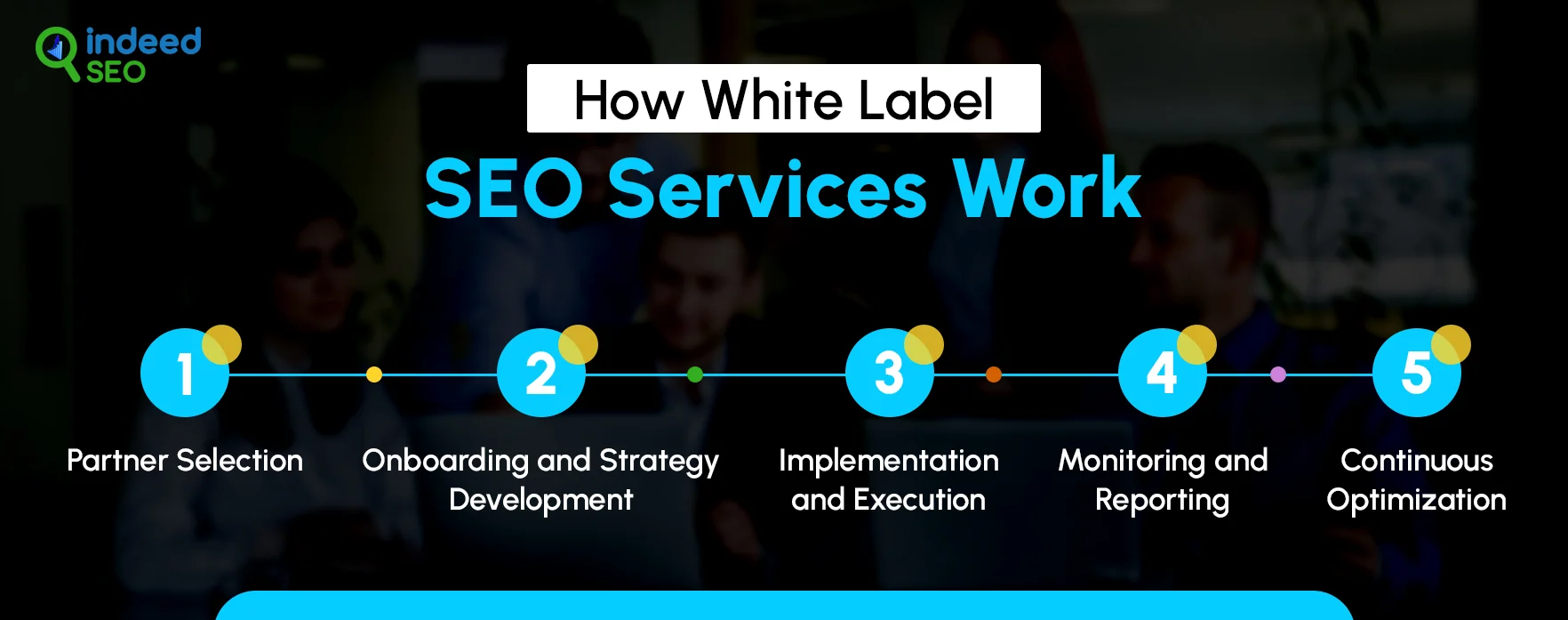
A good white label engagement runs the same five steps every time:
- Pick a partner. Vet them (see the checklist below), ask for a sample report, and start with one client rather than your whole book.
- Onboard the client. You share the client’s goals and access; the provider runs a full-site analysis, competitor research and keyword mapping.
- Do the work. Fixes, content and links get implemented in the order that moves rankings fastest, usually technical first.
- Report. You get a branded monthly report: what was done, how rankings and traffic moved, and what’s next.
- Keep optimizing. SEO compounds, so the plan gets adjusted every month based on what’s working.
Throughout, you stay the single point of contact. Your client never speaks to the provider, and ideally you speak to one account manager, not a ticket queue.
In-house vs freelancer vs white label
| Build in-house | Hire a freelancer | White label provider | |
|---|---|---|---|
| Speed to start | Slow (hiring and training) | Fast | Fast |
| Skills covered | Whatever you hire | Usually one or two | A full team |
| Capacity when you grow | You hire again | Limited by one person | Scales with clients |
| Cost structure | Salaries, tools, training | Hourly or monthly | Per client, per month |
| Quality control | Direct | Direct but limited | You have to manage it |
| Risk | High upfront | Single point of failure | Dependence on the partner |
None of these is automatically best. White label wins when you want to grow faster than you can hire, and in-house wins when SEO is your core product and you want full control.
What it costs and what you can charge
Let’s talk money, because this is where most guides go vague.
What providers charge you. There’s no independent benchmark, and most published figures come from providers selling the service. Vendor guides such as ClicksGeek and Enrich Labs describe roughly this shape per client per month:
- Entry packages: about 600
- Mid-tier packages: about 3,500
- Enterprise: $5,000 and up
These bands disagree with each other, so use them as a sanity check, not a quote. A much lower price usually means less work, thinner reporting or lower-quality links.
What you charge your client. One reseller program states a standard markup of 40–60%, and others claim 50%+ margins. As a simple illustration (not a promise): if you buy a package at $600 a month and sell it to your client at $1,200, you keep $600 a month on that account. Ten clients at that level is $6,000 a month in margin, before your own time for account management.
What IndeedSEO charges. Because we’d rather you see real numbers than a “contact us” wall, our reseller page lists plans starting from $129 a month for basic packages, local SEO from around $200, AI search optimization from $249, and white label PPC at $349 per account. Premium and custom plans are quoted on scope, and bulk discounts of 10–20% apply as client volume grows. See the reseller program for current details.
Whichever provider you choose, ask for the full price in writing: setup fees, one-time tasks, content costs and what happens if you pause a client.
The reports your clients will actually read
Reporting is where white label relationships succeed or fail, because it’s the only thing your client sees. A useful monthly report covers:
- What was done: a plain list of the month’s work.
- What moved: rankings, organic traffic and, ideally, leads or calls.
- What’s next: the plan for the coming month.
- Your branding: your logo, your colors, your name.
A good provider will also help you prepare answers when a client asks a question the report doesn’t cover. Before you sign, ask for a sample report and check it reads like something you’d send, not a data dump. If you want to automate the process, look for a white label dashboard or reporting tool, but remember a dashboard doesn’t replace someone explaining what the numbers mean.
How to vet a provider
Skip the sales deck. These questions tell you far more.
“Can I see a sample report and a sample audit?” If they can’t show real work, that’s your answer. “Who does the work, and where are they based?” Location isn’t automatically a problem, but you need to know about time zones, language and hours of overlap. “How do you build links?” Vague answers or bulk packages are a warning sign.
Then check the practical terms. Is there an NDA on every engagement? Is there a single account manager? Can you start with one client? Are there long-term contracts or minimums? And can you add, pause or move clients between plans without penalty?
Red flags: guaranteed #1 rankings, no sample work, no NDA, hidden setup fees, a ticket system with no named contact, and “link packages” priced per link with no detail on where the links go.
Risks, and how to manage them
White label isn’t risk-free, but the risks are manageable if you plan for them.
Quality. Your name is on the work, so review it. Spot-check the first month’s output, and ask for a clear list of deliverables, not just “SEO services.”
Dependence. If one provider does everything, their problem becomes yours. Start with a small number of clients, and keep your own notes on each account’s strategy.
Confidentiality. Insist on an NDA, and confirm the provider won’t contact your clients or list them as references.
Communication. Delays are the most common complaint. Agree on response times up front, and check working-hour overlap with your time zone.
Transparency. White label is a normal, legal way to deliver work, and many agencies use it. You don’t need to announce your fulfillment partners, but never claim to have an in-house team you don’t have if a client asks directly.
Making the work look like yours
Your clients should see one brand, from the first proposal to the last report. A few habits help:
- Use your own report template, or a provider’s branded template with your logo and colors.
- Have one person on your side own all client communication.
- Match the tone of the reports to how you talk to clients, plain English and no jargon.
- Keep your own record of what was done each month, so you can answer questions without waiting for the provider.
Why this matters more in 2027
Search is changing, and clients are asking about it. Clicks are concentrated at the top: Backlinko’s analysis of 4 million Google results found the first organic result gets about 27.6% of clicks, and only around 0.63% of searchers click anything on the second page. And AI summaries are eating into those clicks: Ahrefs has reported roughly 58% lower click-through for the top organic result when an AI Overview appears. (We checked these through secondary roundups; see the editor note for the originals.)
For an agency, that means two things. First, “ranking somewhere” isn’t a result; page one is. Second, clients will want to know how they show up in ChatGPT, Gemini and Google’s AI answers, so look for a provider that offers answer engine optimization too. If you want to dig into that, see our overview of AEO services.
Where IndeedSEO fits
Since this is our guide, here’s where we stand, using only what our own pages state.
IndeedSEO has been in business since 2012, says it has done more than 250 white label collaborations, and is a Google Partner and a Semrush Agency Partner. Our white label SEO services cover audits, on-page, technical, link building, local SEO and content, with add-ons such as paid search, social, reputation management and AI search optimization.
How it works for agencies: an NDA is signed on every engagement, one account manager is your single point of contact, and our team doesn’t appear in front of your clients. Every plan includes a monthly branded report, there are no long-term contracts or minimums, and you can start with a single client. The delivery team is based in India, which is how we keep pricing low, and we have a US office in Helotes, Texas. Working hours overlap with UK and Australian business days, and calls are scheduled during North American mornings.
Not sure we’re the right fit? That’s fine. Ask for a sample report first, and use the questions above on us the way you would on anyone else. You can also see how our work performs in our case studies.
Ready to add SEO without the hiring headache?
Start with one client, ask for a sample report and see how it goes. If you’d like to talk through what you need, book a free consultation with IndeedSEO or explore the reseller program.
Ready to scale your agency without hiring an in-house team? Partner with our White Label SEO experts today.
Frequently asked questions
What is white label SEO?
White label SEO is when a provider does SEO work and an agency or freelancer sells it to their own client under their own brand. The provider stays behind the scenes and the agency owns the client relationship.
How does white label SEO work?
You choose a provider, share your client’s goals, and the provider runs the audit, optimization, content and link work. You receive branded reports each month and present them as your own.
How much does white label SEO cost?
Published figures vary widely. Vendor guides describe about 600 per client a month for entry packages and 3,500 for mid-tier plans. IndeedSEO lists plans starting from $129 a month. Always get the full price, including setup fees, in writing.
How much should I mark up white label SEO?
One reseller program states a typical markup of 40–60%. The right number depends on your market, your account-management time and what the client would otherwise pay.
Is white label SEO legit and safe for Google?
Yes, it’s a common and legal way to deliver SEO. The risk is in the work, not the model: low-quality links or spammy content can hurt a site. Ask how the provider builds links and what’s included in each package.
What should I look for in a white label SEO partner?
A sample report, a named account manager, an NDA, clear deliverables, no long-term lock-in, and honest answers about who does the work and where they’re based.
What is a white label SEO report?
It’s a monthly report carrying your agency’s branding, summarizing completed work, ranking and traffic movement, and the next steps. Reporting is why many agencies choose white label in the first place.
Do I need to tell my clients I outsource?
You don’t have to announce your fulfillment partners, and an NDA protects both sides. But if a client asks directly, be honest rather than claiming an in-house team you don’t have.
Is white label SEO worth it?
For agencies that want to add a service without hiring, usually yes, provided you vet the provider and review the work. If SEO is your core product and quality control is critical, building in-house may suit you better.
PakarPBN
A Private Blog Network (PBN) is a collection of websites that are controlled by a single individual or organization and used primarily to build backlinks to a “money site” in order to influence its ranking in search engines such as Google. The core idea behind a PBN is based on the importance of backlinks in Google’s ranking algorithm. Since Google views backlinks as signals of authority and trust, some website owners attempt to artificially create these signals through a controlled network of sites.
In a typical PBN setup, the owner acquires expired or aged domains that already have existing authority, backlinks, and history. These domains are rebuilt with new content and hosted separately, often using different IP addresses, hosting providers, themes, and ownership details to make them appear unrelated. Within the content published on these sites, links are strategically placed that point to the main website the owner wants to rank higher. By doing this, the owner attempts to pass link equity (also known as “link juice”) from the PBN sites to the target website.
The purpose of a PBN is to give the impression that the target website is naturally earning links from multiple independent sources. If done effectively, this can temporarily improve keyword rankings, increase organic visibility, and drive more traffic from search results.
Comments are closed, but trackbacks and pingbacks are open.